



For GSC Commodity Intelligence, substantial pullbacks offer a chance to build exposure to Commodities before the structural pressures behind The Hard Asset Decade become fully reflected in prices.
Goldman’s reported recommendation supports a positive Commodity allocation to hedge geopolitical tensions and supply disruption. GSC takes that discussion further: the time to prepare for the next phase may be while markets are still questioning it.
When Commodities Go On Sale, Smart Money Moves Fast
Seasoned traders understand one simple rule: when Commodities go on sale during a powerful macro cycle, you do not wait for the crowd to confirm the opportunity. You act before the repricing becomes obvious.
Unlike shares, Commodities cannot be printed, diluted or created with a keystroke.
Oil fields take years to develop. Copper mines take a decade or more to bring online. Silver supply cannot instantly respond to investment demand. Natural Gas infrastructure requires huge capital, regulation and time. Gold cannot be manufactured by central banks.
That is why pullbacks in Commodities can be so deceptive. They look like weakness in the moment, but in the right macro environment, they can become rare accumulation windows before the next explosive move higher.
In a recent client note, analysts at The Gold & Silver Club reaffirmed their view that “this is The Hard Asset Decade”, arguing that substantial pullbacks should be viewed as opportunities to accumulate.
“Waiting until confidence returns can mean paying a higher price for the same underlying opportunity,” says Lars Hansen, Head of Research at The Gold & Silver Club. “The demand story has not disappeared – the market is simply giving traders a temporary discount.”
Copper Price Forecast
Every new Copper analysis as it publishes, today's technical signal and key levels, live price — on one page.
See all Copper forecastsSeven Megatrends That a Pullback Cannot Erase
The structural forces behind The Gold & Silver Club’s longer-term thesis remain intact. Its case connects seven megatrends: Deglobalization, Energy Security, Geopolitical Conflict, Infrastructure Expansion, Resource Nationalism, Central Bank Reserve Diversification and Artificial Intelligence.
Deglobalization and resource nationalism can restrict access to dependable suppliers. Conflict exposes transport chokepoints. Energy security and infrastructure renewal require physical investment. AI increases electricity demand, while reserve diversification reinforces Gold’s strategic role.
For GSC, lower prices have not removed the need for new mines, stronger electricity networks or secure energy supplies.
“The more digital the economy becomes, the more its resilience depends on physical resources,” says Hansen. “You cannot run an economy on confidence alone. You need energy, metals and infrastructure that work.”
Two forces make that argument particularly tangible: the infrastructure needed to expand the digital economy and the ageing systems that must be replaced to keep the existing economy running.
Anthropic’s $900 Billion Commitment Exposes AI’s Scarce Layers
Anthropic’s infrastructure commitments reveal the scale of the AI race. The Claude maker has disclosed approximately $900.9 billion in purchase and lease commitments, substantially all related to compute and infrastructure. Around $451.6 billion is expected before the end of 2030, with substantially all the remainder between 2031 and 2045.
For GSC Commodity Intelligence, the greatest opportunity lies in AI’s “scarce layers”: the power, networks and equipment needed to deliver that capacity, including their requirements for Copper, Aluminium and other strategic materials.
The IEA projects global data-centre electricity consumption roughly doubling from 485 terawatt-hours in 2025 to 950 TWh in 2030. New grid infrastructure can take five to 15 years to develop, compared with one to three years for data centres.
“The AI race is also a race for strategic Commodities and Hard Assets,” Hansen says. “Traders should ask who owns the physical capacity that makes the next wave of technological growth possible.”
America’s $50 Billion Warning Makes Renewal Urgent
On 13 November 2026, a telecommunications failure prompted a nationwide halt to U.S flight departures. Transport secretary Sean Duffy cited “1980s little Copper lines” and called for $50 billion to modernize aviation infrastructure.
That remains a funding request. The disruption illustrates how costly deferred modernisation can become. Across the wider economy, ageing systems require renewal just as AI and electrification demand additional capacity.
The IEA estimates 25 million kilometres of power lines must be added or replaced worldwide by 2035 to meet expected electricity demand.
For GSC, renewal and expansion are converging on the same physical supply chains. Together, those demands can intensify pressure on Copper and base metals before new supply catches up.
Copper and Gold Reveal Two Sides of the Same Shift
Copper reflects the investment required to expand and renew the physical economy. Gold reflects the parallel demand for financial resilience and reserve diversification.
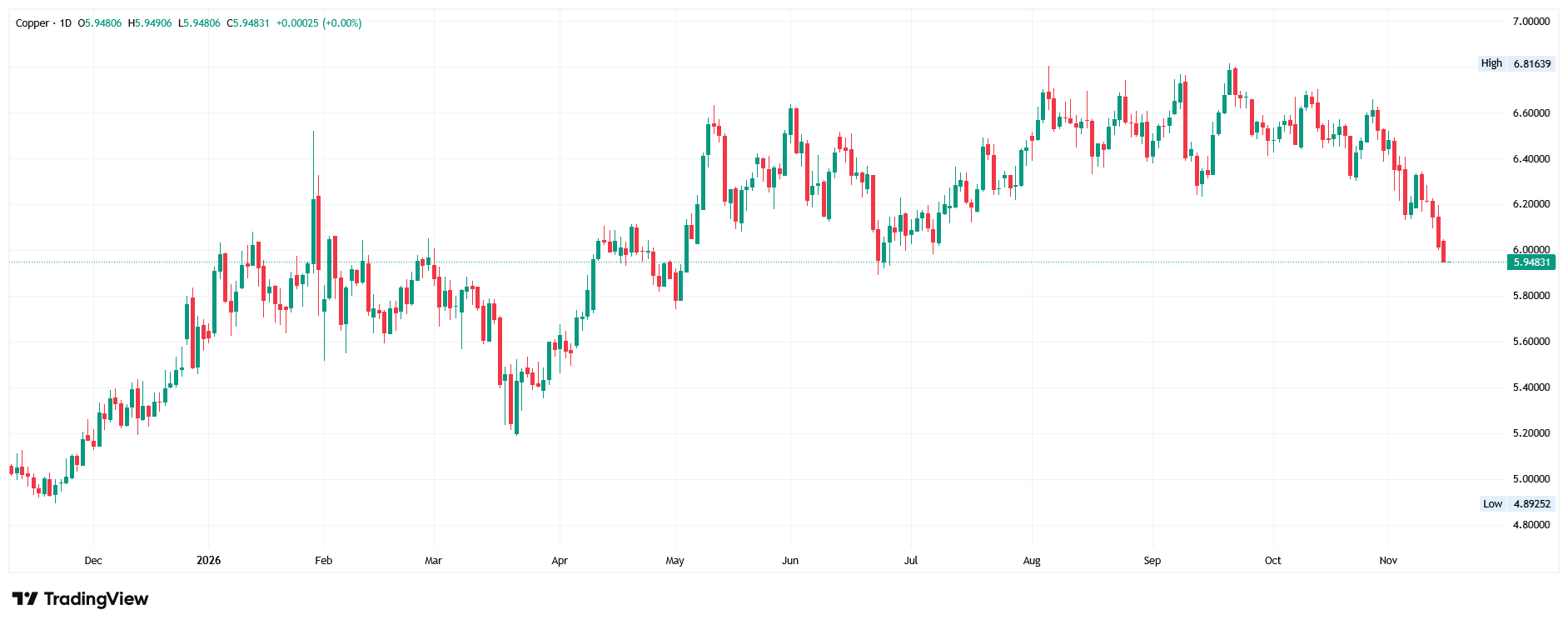
Goldman’s December 2027 Copper target is $15,600 a tonne. The IEA identifies a potential 25% shortfall in primary Copper supply against 2035 requirements under stated policies, based on existing and announced projects.
Meanwhile, the World Gold Council estimates central banks and other official institutions bought 675 tonnes net during the first nine months of 2026, 6% more than a year earlier, including estimates of undisclosed purchases.
The Cost of Waiting for the Obvious
For The Gold & Silver Club, waiting for the opportunity to become obvious carries a cost of its own: markets can reprice a supply constraint long before new capacity is available to resolve it.
That is why the firm views substantial pullbacks in Commodities as potential accumulation opportunities within a much longer structural cycle.
The firm believes the convergence of its seven megatrends could create one of the most significant Hard Asset wealth creation opportunities of our lifetime. At the heart of that thesis sits an increasingly uncomfortable conclusion: “None of Us Own Enough Hard Assets”.
As Hansen puts it: “This is not just a Commodities trade. This is a global repricing of scarcity. Traders who understand that early may be the ones who benefit most.”
The Gold & Silver Club believes the accumulation window is open now. But in Commodity markets, these windows rarely stay open for long.
Where are prices heading next? Watch The Commodity Report now, for my latest price forecasts and predictions: