



The Aussie is down some 7% since early September and is on course to record its largest monthly decline in almost two years. AUDUSD has been falling for four consecutive weeks now and is now trading near year-to-date (y-t-d) lows. Should the psychological support near 0.6650 get broken, the Aussie may fall even further.
What is driving AUDUSD’s relentless decline? A policy shift from the Federal Reserve (Fed) and, as a result, a widening divergence in monetary policy expectations between the U.S. and Australia seem to be the most obvious answer. However, more factors are at play here. According to Elev8, a global CFD broker, AUD ranks as the most oversold major currency right now, based on positioning by large funds in futures and options markets. Paradoxically, however, this deep gloom could spark a swift recovery.
Who Is to Blame for the AUD/USD Decline?
Firstly, blame the U.S. dollar (USD). To a large extent, AUDUSD trades as a function of the USD direction rather than domestic Australian factors. The Fed raised rates in September, and traders now price in a near 100% probability of another rate hike in December. Additionally, higher-than-expected U.S. inflation figures have driven the U.S. 10-year Treasury yield above 5% and pushed the U.S. Dollar Index (DXY) to its highest level since April 2025.
Concurrently, while the Reserve Bank of Australia (RBA) raised its cash rate to 4.85% in November, market participants interpreted the move as a dovish hike because the vote at the Monetary Policy Board was narrowly split (6 to 3). Investors treated the move as a sign that the current tightening cycle may be coming to an end. Australian employment data also missed expectations, with the unemployment rate rising to a five-year high, reducing the probability of further RBA hikes. Meanwhile, as already said, the Fed is expected to continue tightening, widening the policy divergence.
Falling commodity prices also weakened the Aussie. Australia is a major commodity exporter, and gold, silver, copper, and iron ore have all been trending lower lately. Gold fell to a one-year low, copper dropped to a four-month low, and iron ore futures have declined roughly 19% since May. Furthermore, the stronger greenback has made dollar-denominated commodities more expensive for holders of other currencies, compounding the downward pressure.
China added to the pain. As Australia’s top trading partner, China’s demand essentially dictates whether AUDUSD finds itself in a bullish or bearish trend. Yet the latest economic news out of Beijing was not particularly encouraging. China’s October industrial output and retail sales grew much more slowly than expected. Additionally, state buyers in China want cheaper terms from Aussie mines, a move that could weigh on Australia’s trade balance.
Finally, because the Aussie often acts as an FX proxy for global risk, broader market jitters haven’t done the currency any favours. A pullback in U.S. tech stocks, with NASDAQ futures dropping below the 200-day moving average (DMA), added to the pressure. The Philadelphia SE Semiconductor Index has dropped by 5.3%, and Nvidia’s CEO resignation sparked further uncertainty about the AI trade.
AUD/USD Price Forecast
Every new AUD/USD analysis as it publishes, today's technical signal and key levels, live price — on one page.
See all AUD/USD forecastsPotential Recovery Maybe?
AUDUSD headwinds are plenty, but too much pessimism also creates rare chances. The latest U.S. Commodity Futures Trading Commission’s (CFTC) Commitments of Traders (COT) report has revealed that as of 10 November, non-commercial players (large traders and hedge funds) held as many as 252,199 gross short contracts and 157,087 net short contracts in AUD futures and options combined. This represents the largest short exposure in AUD in at least 16 years (since January 2010, as earlier data is not available). However, nominal numbers don’t tell the whole story.
To find true exhaustion points, we use a Relative Sentiment Index (0-100) based on a rolling three-year window. A reading of 100 and above indicates that traders’ positioning is at a 3-year high (technically, ‘overbought’), while a reading of 0 and below indicates that positioning is at a 3-year low (technically, ‘oversold’). By this measure, the Australian dollar is currently the most oversold currency among the majors (see the chart below).
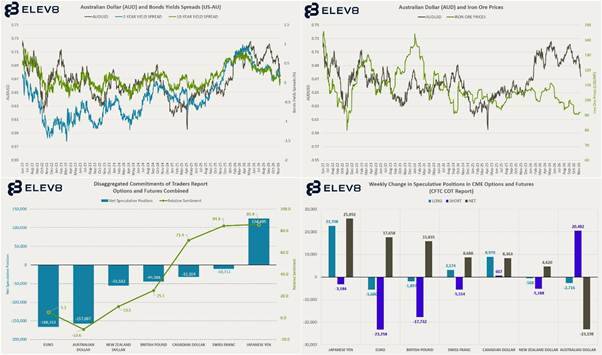
Indeed, this massive short positioning sets a potential trap. Paradoxically, it could trigger a recovery in AUDUSD by creating exactly the conditions necessary for a rapid short-covering rally. It can happen if short-sellers head for the exit and begin buying back the currency. Because the short side of the trade is so heavily overcrowded, panic buying may ensue, resulting in a swift reversal.
However, initiating a contrarian trade and going long AUDUSD solely on the basis of extreme positioning is unwise. Traders should always look for technical signals that confirm a bottom before entering a position. It could be a doji daily candlestick, bullish divergence on oscillators (such as the Relative Strength Index), or a decisive break above key resistance.
Other fundamental factors may also help. The geopolitical situation remains tense, but peace talks led by Qatar and Pakistan show fresh promise. Crude oil has already fallen roughly 20% from its October peak, helping to improve global risk sentiment. Also, traders should not count out the RBA. Bank chief Michele Bullock spoke firmly in mid-November, noting that price risks were still high. If the central bank vows to keep rates high, the gap in interest-rate expectations between the U.S. and Australia will start to narrow, and AUDUSD bears will flee. Until then, traders should monitor the support level near 0.6650 and watch the upcoming Australian CPI data (due next Wednesday) alongside the RBA’s December policy meeting for any signs of a shift.
Disclaimer: This article does not contain or constitute investment advice or recommendations and does not consider your investment objectives, financial situation, or needs. Any actions taken based on this content are at your sole discretion and risk—Elev8 does not accept any liability for any resulting losses or consequences.